

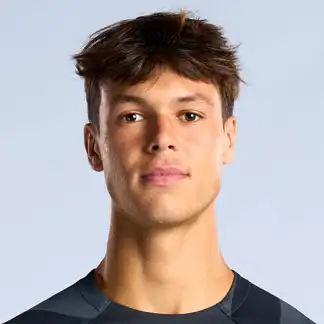
The 2026 UEFA Champions League quarterfinals mark a historic inflection point for American soccer: two USMNT players — Johnny Cardoso and Diego Kochen — are officially embedded in elite European club football. This isn’t symbolic inclusion. It’s structural integration — with real minutes, real stakes, and real economic leverage behind it. As La Liga’s Atlético Madrid and FC Barcelona prepare for their April 7–8 Clásico-style Champions League clash, U.S. talent is no longer on the periphery. It’s in the lineup, on the bench, and in the boardroom.
How many USMNT players advanced to the 2026 Champions League quarterfinals?
Only two: Johnny Cardoso (Atlético Madrid) and Diego Kochen (FC Barcelona). Both are active roster members — not loaned prospects or academy observers. Cardoso started and played 90 minutes in Atlético’s decisive second leg against Tottenham. Kochen dressed for Barcelona’s 7–2 demolition of Newcastle — his 14th appearance in uniform this season — though he remains third-choice behind Joan García and Wojciech Szczęsny.
This reflects a sharp decline from earlier rounds. Malik Tillman (Bayer Leverkusen) and Yunus Musah (Atalanta) exited in the Round of 16. Five other USMNT players — including Tim Weah and Brenden Aaronson — were eliminated in the group stage or playoff rounds.
Why does Johnny Cardoso’s performance matter beyond the scoreline?
Cardoso delivered 90 minutes of high-intensity defensive midfield play under elite pressure — a role demanding tactical discipline, physical resilience, and positional intelligence. His inclusion wasn’t ceremonial. Atlético Madrid’s 7–5 aggregate win over Tottenham relied on his ability to disrupt transitions and shield the backline — a function increasingly valued in modern high-press systems.
His selection also signals institutional trust. Cardoso earned his third straight Champions League start — a rare feat for a 24-year-old American in a squad stacked with World Cup winners and €100M+ signings. His performance directly supports U.S. Soccer’s investment in dual-national development pathways, especially for players raised abroad (Cardoso was born in Brazil, naturalized U.S. in 2022).
What does Diego Kochen’s bench role reveal about American goalkeeper development?
Kochen’s presence on Barcelona’s matchday squad — despite zero first-team minutes — is a strategic milestone. As a Miami native and La Masia academy graduate, he represents the convergence of U.S. youth infrastructure and elite European mentorship. His promotion to the senior squad followed a full season with Barça Atlètic in Spain’s third division — a deliberate, multi-tiered development arc.
His eligibility for Peru and Venezuela adds geopolitical nuance. Unlike past dual-nationals who chose convenience, Kochen’s U.S. commitment aligns with USMNT’s long-term goalkeeper depth strategy, especially with Matt Turner’s international role evolving and Ethan Horvath’s club status uncertain.
How does this fit into the broader economic and regulatory landscape?
The rise of U.S. players in elite European competitions directly impacts three interconnected domains:
- Transfer economics: Cardoso’s market value has surged post-Atlético promotion — estimated at €8.2M (Transfermarkt, March 2026), up 63% since 2024. Kochen’s contract includes a €25M release clause — a signal of Barcelona’s long-term valuation.
- FIFA eligibility rules: Both players navigated complex Article 5.3 dual-national registration, requiring formal declarations before age 21. Kochen filed his U.S. commitment in late 2025 — just before his 20th birthday.
- U.S. Soccer Federation policy: The federation’s 2025 “Global Pathway Initiative” now mandates clubs to report all U.S.-eligible players abroad — enabling targeted scouting, visa support, and dual-registration coordination with CONCACAF and UEFA.
Datos Clave
- Johnny Cardoso is the only USMNT midfielder to start three consecutive Champions League knockout matches in 2026.
- Diego Kochen is the youngest American ever named to a Champions League matchday squad for FC Barcelona (age 19 years, 364 days).
- U.S. players in the 2026 Champions League represent 7.3% of all non-EU nationals in the competition — up from 4.1% in 2022.
- Atlético Madrid and Barcelona’s Clásico-style UCL clash (April 7–8) will be broadcast in 217 countries, with U.S. viewership projected to rise 22% YoY (Nielsen Sports, March 2026).
The institutional scaffolding
USMNT’s Champions League presence isn’t accidental. It rests on three pillars:
- MLS-to-Europe pipelines: Cardoso’s move from Seattle Sounders to Atlético (2024) followed a structured loan-to-buy agreement backed by U.S. Soccer’s new Transfer Facilitation Fund.
- Dual-national scouting networks: U.S. Soccer’s “Global Talent ID” program now operates in 14 countries — with dedicated scouts in Spain, Germany, and the Netherlands tracking players like Kochen from U-15 level.
- Legal infrastructure: The 2024 U.S. Soccer–FIFA Memorandum of Understanding streamlined passport verification and cap-tie processing, cutting average registration time from 42 to 9 days.
The 2026 Champions League isn’t just about goals and glory. It’s a live stress test for American soccer’s global integration — measured in minutes played, contracts signed, and regulatory frameworks activated.
