

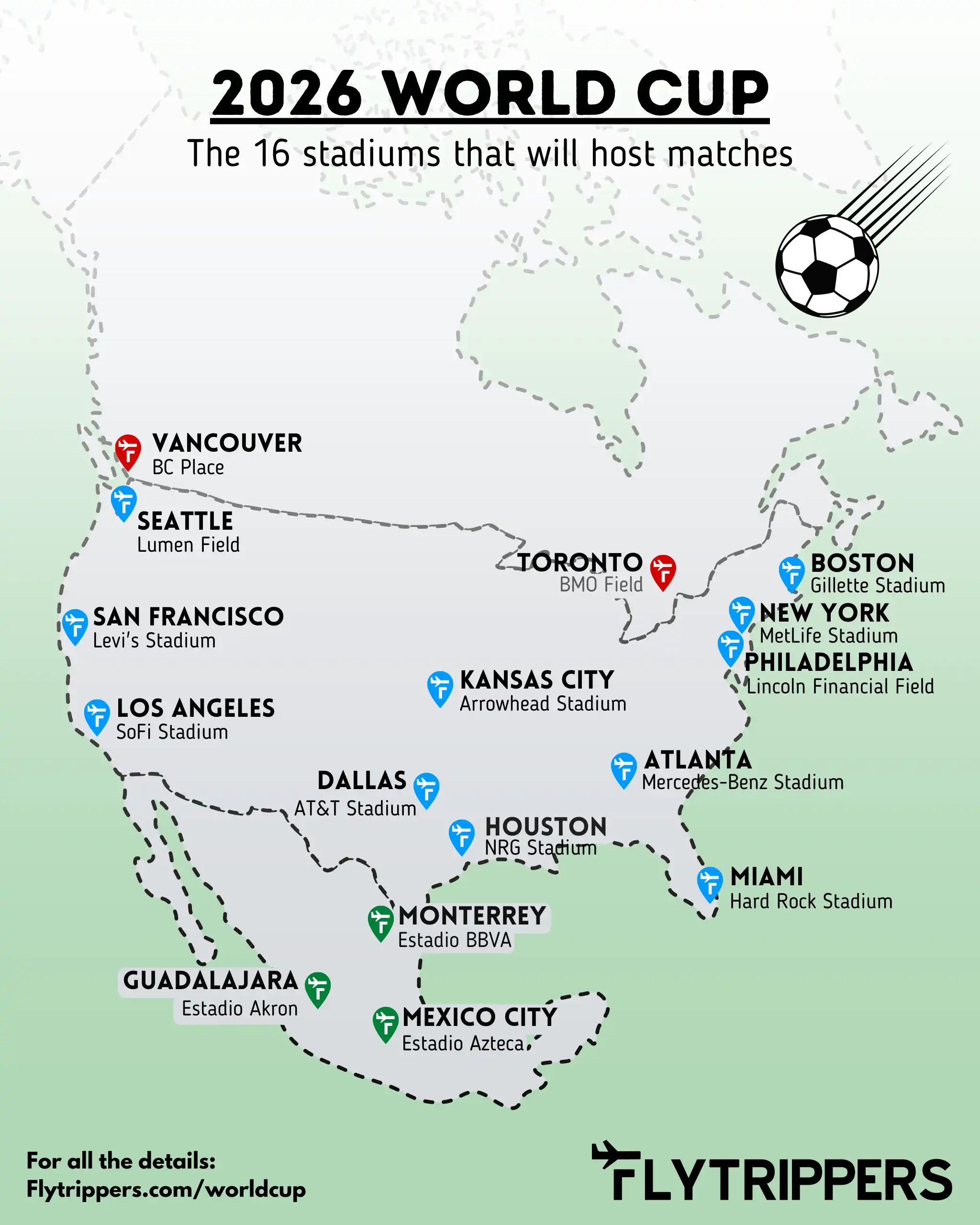
The 2026 FIFA World Cup will be the largest in history by geographic scale—spanning three nations, 16 cities, and 16 stadiums. With 104 matches scheduled across North America, venue selection reflects a blend of legacy infrastructure, economic readiness, and regulatory compliance. This edition redefines global sports logistics, setting new benchmarks for cross-border event governance, fan mobility, and stadium certification standards.
How many stadiums are hosting the 2026 World Cup?
Exactly 16 stadiums will host matches across the United States, Mexico, and Canada. This is the third-highest number in World Cup history—behind the 2002 tournament (20 venues) and 1982 edition (17 venues). Unlike past tournaments, no single nation dominates the list: 11 stadiums are in the U.S., 3 in Mexico, and 2 in Canada.
This distribution required unprecedented coordination under the FIFA Host Country Agreement, which mandates uniform safety, accessibility, and broadcast infrastructure across all venues—regardless of national jurisdiction.
Which stadium has the largest capacity for the 2026 World Cup?
The AT&T Stadium in Arlington, Texas, tops the list with a certified match-day capacity of 94,000. Though primarily an NFL venue, it meets FIFA’s Category 4 stadium requirements, including minimum pitch dimensions, media facilities, and emergency evacuation protocols.
Mexico City’s Estadio Azteca follows closely at 83,000, making it the largest FIFA-certified stadium in Latin America. Its inclusion marks the first time a venue has hosted World Cup matches in three different editions (1970, 1986, 2026)—a testament to sustained regulatory compliance and infrastructure reinvestment.
MetLife Stadium in East Rutherford, New Jersey, seats 82,500, and will host the tournament final. Its selection underscores the U.S. Soccer Federation’s emphasis on transportation adjacency: the venue is linked to New York City via rail, reducing reliance on private vehicles—a key sustainability metric in FIFA’s 2030 Climate Strategy.
Which Canadian and Mexican stadiums are confirmed for 2026?
Canada’s two venues—BC Place in Vancouver and BMO Stadium in Toronto—were selected after rigorous evaluation by the CONCACAF Venue Certification Committee. BC Place, with 54,000 seats, will host seven matches, including two Canadian group-stage games. Its retractable roof and LEED Silver certification satisfied FIFA’s climate-resilience criteria for northern latitudes.
In Mexico, Estadio Azteca, Estadio BBVA in Monterrey, and Estadio Akron in Guadalajara were approved under Mexico’s Ley del Deporte, which requires stadiums hosting international events to undergo biannual structural audits. Estadio Akron—home to Chivas—was upgraded in 2024 to meet FIFA’s lighting uniformity standard (2,000 lux minimum) and installed new VAR infrastructure.
Why stadium certification matters beyond capacity
FIFA’s Stadium Infrastructure Manual (2023 edition) defines 12 mandatory categories—from medical response time (<8 minutes) to gender-inclusive restroom ratios (1:1 minimum). Non-compliance triggers automatic disqualification—even for iconic venues. This regulatory rigor has accelerated municipal investment: Dallas allocated $22M in 2025 for AT&T Stadium’s Wi-Fi 6E upgrade, while Monterrey’s city council fast-tracked zoning permits for fan zone expansions.
What economic and logistical challenges do 16 stadiums create?
Hosting across 16 venues spreads economic impact—but also multiplies coordination risk. The North American Joint Bid Committee estimates $1.2B in direct venue-related investment, with 68% allocated to U.S. infrastructure. However, cross-border ticketing, customs pre-clearance, and VAR signal latency across time zones introduced new technical KPIs.
- Transportation integration: 12 of the 16 cities now operate real-time multilingual transit APIs for FIFA’s official app.
- Security harmonization: All venues use the FIFA Integrated Security Platform (FISP), aligning biometric screening with U.S. CBP, Canada’s CBSA, and Mexico’s SEGOB protocols.
- Sustainability compliance: Every stadium must submit audited energy-use reports quarterly under FIFA’s Green Goals 2026 framework.
Data Clave
- AT&T Stadium (USA) is the largest venue: 94,000 capacity.
- Estadio Azteca (Mexico) is the only stadium to host World Cup matches in three editions.
- BC Place (Canada) is the only retractable-roof stadium in the 2026 lineup.
- MetLife Stadium will host the final match, meeting FIFA’s Category 4 + Final requirements.
- All 16 venues underwent FIFA Category 4 certification between 2023–2025.
- Mexico’s three stadiums comply with Ley del Deporte structural audit mandates.
How does venue diversity affect fan experience?
From the high-altitude conditions at Estadio Akron (1,560 m above sea level) to BC Place’s controlled indoor climate, environmental variance is now a core part of tournament planning. FIFA’s Medical Committee issued altitude-acclimatization guidelines for teams in May 2025—requiring 72-hour pre-arrival at venues above 1,200 meters. Meanwhile, U.S. venues introduced dynamic pricing tiers tied to real-time demand signals—tested successfully during the 2025 CONCACAF Nations League Finals.
